Community Chat is live with 1,000+ traders inside. Connect Telegram and trade alongside them.
Edition 1 · Free Guide
THE POLYMARKET PLAYBOOK
A complete beginner's guide.
Everything you need to start analyzing Polymarket prediction markets — fair value, smart money, order types, sizing, and the most common beginner mistakes. Brought to you by TrueOdds.
TrueOdds is an educational tool and information service. We do not offer investment advice, guaranteed returns, or financial products. Prediction markets carry risk of loss. Past performance does not predict future results.
Educational content. Not financial advice.
Chapter 01
Welcome — Why Prediction Markets Matter
Markets are the best lie detector humans ever invented. When real money is on the line, opinions get honest fast.
If you have ever watched a news show, scrolled X during an election night, or argued with a friend about whether the Fed will cut rates next month, you already think probabilistically. You just rarely get paid for being right. Prediction markets change that.
A prediction market is a place where people buy and sell contracts that pay out based on a real-world outcome. "Will Bitcoin close above $150k by December 31?" "Will the Lakers win tonight?" "Will the next CPI print be above 3.2%?" Each contract is a yes or a no, and its price reflects the crowd's best guess at the probability the answer is yes.
The wisdom-of-the-crowd effect, combined with skin in the game, makes prediction markets remarkably accurate forecasters. Academic studies have found that prediction markets often beat polls, pundits, and even specialized expert panels. That is partly why investors, journalists, policymakers, and traders increasingly watch them as a real-time signal of what is likely to happen.
Why Polymarket specifically?
Polymarket is the largest crypto-native prediction market in the world. It runs on the Polygon blockchain, settles trades in USDC (a US-dollar stablecoin), and lists thousands of markets across politics, crypto, sports, economics, weather, pop culture, science, and more. In November 2025, US users gained regulated access through Polymarket's CFTC-licensed infrastructure, opening the door to mainstream adoption in the United States.
For a trader, three things make Polymarket special: deep liquidity in the biggest markets, transparent on-chain order books, and a 0% trading fee structure on most pairs. For a curious citizen, it is simply the most honest scoreboard for "what is actually going to happen" you can find.
What you'll be able to do by the end of this guide
Open and fund an account safely. Read any market price as a probability. Place limit and market orders without overpaying. Size positions so a bad run cannot wipe you out. Spot mispriced markets where you have a real edge. And know exactly which tools to use — including TrueOdds — to do all of the above faster.
Chapter 02
What Is Polymarket?
Think of it as a stock exchange — but instead of trading shares of companies, you trade shares of "this will happen" and "this won't."
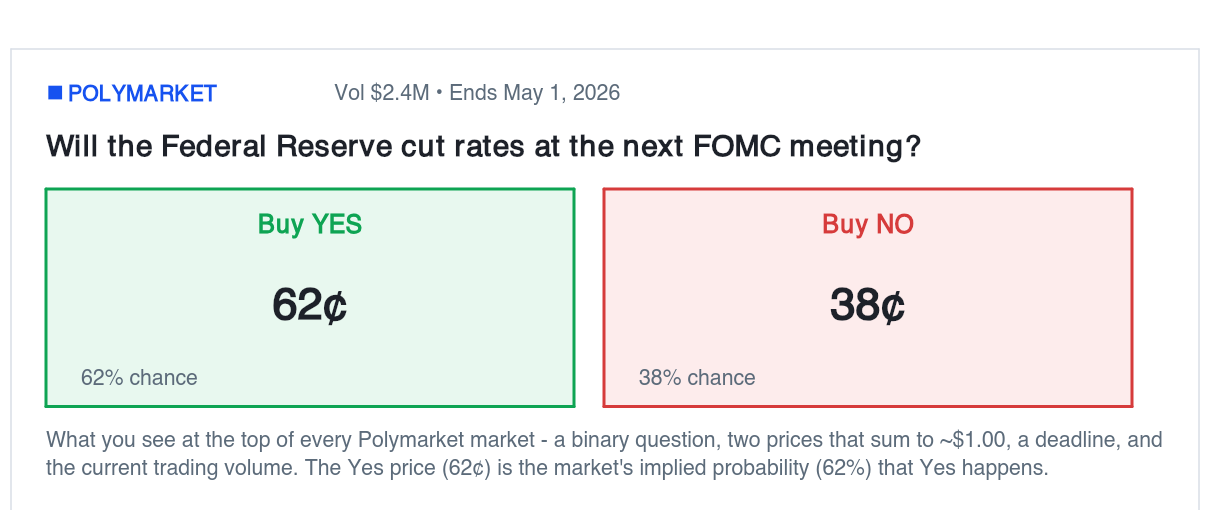
Polymarket is a decentralized prediction market platform launched in 2020 and built on the Polygon network, an Ethereum scaling layer. Every market on Polymarket is structured as a binary contract: a question with a Yes side and a No side. Each side trades between $0.00 and $1.00. When the market resolves, the winning side pays out exactly $1.00 per share. The losing side pays $0.00.
If you buy a share of "Yes — Lakers win" at $0.62 and the Lakers win, you collect $1.00 — a profit of $0.38 per share, or about 61%. If they lose, your share is worth $0.00. The price you pay is, essentially, the market's probability estimate that Yes will happen. $0.62 means "the market thinks there is a 62% chance the Lakers win."
Key facts to memorize
- Currency: trades settle in USDC, a fully-backed US-dollar stablecoin.
- Blockchain: orders, fills, and balances live on Polygon. You truly own your shares.
- Fees: Polymarket has historically charged 0% trading fees on most major markets — you only pay the spread.
- Custody: when you create an account, a smart wallet is generated for you. You can also connect MetaMask, Coinbase Wallet, or another Web3 wallet.
- Resolution: markets settle based on a public, agreed-upon source (e.g., AP race calls, CoinGecko price, the official scoreboard).
- Regulation: as of November 2025, US users can trade Polymarket markets through its CFTC-regulated entity.
What can you trade?
Polymarket lists thousands of markets across roughly seven categories. Politics and elections drive the headlines, but they are far from the only thing happening on the platform.
| Category | Examples |
|---|---|
| Politics & Elections | Presidential winner, Senate control, country leadership changes, ballot measures |
| Crypto | Bitcoin and Ethereum price targets, ETF approvals, hard-fork outcomes |
| Sports | Championship winners, season MVPs, in-season win totals, individual game props |
| Macro & Economics | Fed rate decisions, CPI prints, recession calls, jobs report ranges |
| Pop Culture & Media | Box-office totals, awards-show winners, song-chart positions |
| Science & Tech | Product launches, AI benchmarks, model release dates, hurricane landfalls |
| Geopolitics | Treaty signings, conflict outcomes, leadership transitions |
Chapter 03
How Prediction Markets Actually Work
Once you understand that price equals probability, every other concept you'll meet on Polymarket clicks into place.
The two-sided contract
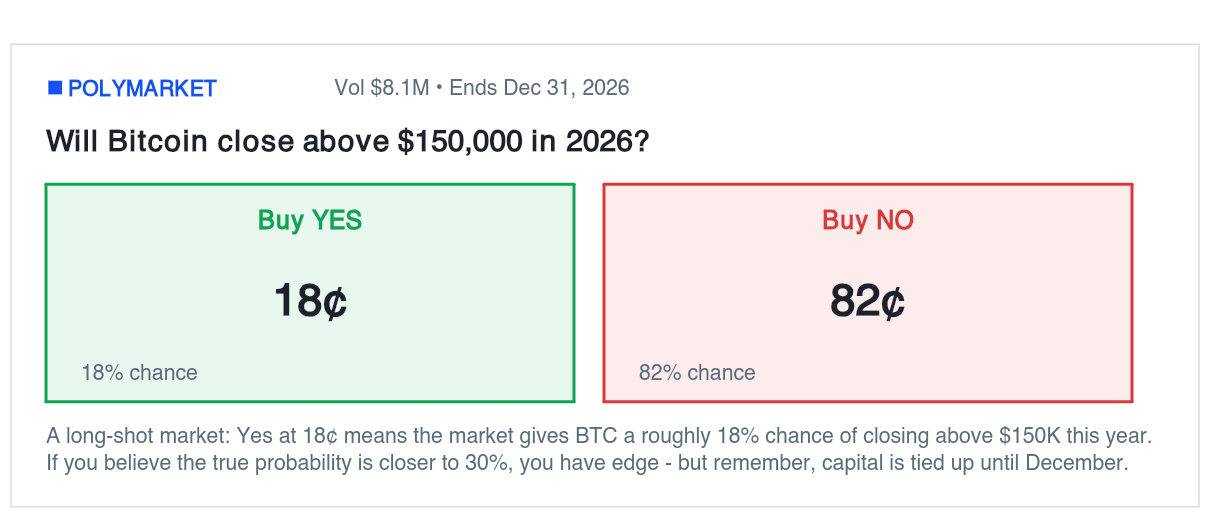
Every Polymarket market has two outcomes: Yes and No. Their prices always sum to roughly $1.00 (within a tiny spread). If "Yes" trades at $0.65, "No" will trade at about $0.35. They are mirrors of each other. When you buy a Yes share, you are also implicitly betting against No. You do not have to pick a side and hope — you are buying a clearly priced claim on the outcome.
Where the money comes from
The other side of every trade is another trader. Polymarket is a peer-to-peer order book, not a casino with a house edge. When you buy Yes at $0.65, someone else just sold you that Yes for $0.65 — and effectively took the No side at $0.35. At resolution, exactly $1.00 changes hands between the two of you per share. This is structurally different from sportsbooks (which build a vig into every line) and from lotteries (which keep a huge cut up front). On Polymarket, you are trading against another person's opinion, not against a house.
The probability translation
The single most important habit a Polymarket trader can build is translating prices to probabilities — and back again — instantly.
| Yes price | Implied probability of Yes | Implied probability of No |
|---|---|---|
| $0.05 | 5% | 95% |
| $0.20 | 20% | 80% |
| $0.50 | 50% | 50% |
| $0.65 | 65% | 35% |
| $0.80 | 80% | 20% |
| $0.95 | 95% | 5% |
Price (in dollars) equals implied probability (as a fraction).
Chapter 04
Setting Up Your Account & Funding It
The smoothest path from “curious” to “placing your first trade” — with the safety habits that separate amateurs from professionals.
Step 1 — Create an account
Go to polymarket.com (or download the official mobile app). Sign up with an email address or with a Web3 wallet such as MetaMask or Coinbase Wallet. If you sign up with email, Polymarket will provision a smart wallet for you in the background — a self-custodial wallet that you control via a magic link, social login, or recovery phrase.
If you are based in the United States, complete the identity verification (KYC) step on first login. As of November 2025, US users trade through a regulated entity that requires KYC for compliance. The verification is fast and only needs to be done once.
Step 2 — Fund your wallet with USDC
All trades happen in USDC on the Polygon network. You have three common ways to fund:
- Buy crypto with a card directly inside Polymarket (powered by Moonpay or a similar partner). Easiest for beginners. There is a small spread compared to spot rates.
- Bridge from another chain. If you already hold USDC on Ethereum, Arbitrum, Base, or Solana, you can bridge it to Polygon using a service like Across, Stargate, or LI.FI.
- Send from a centralized exchange. Withdraw USDC on Polygon directly from Coinbase, Kraken, Binance, or similar. Triple-check the network selection — sending USDC on the wrong chain can lose your funds.
Step 3 — Tour the interface
Once funded, take five minutes to wander. Notice the four screens you'll live in:
- Markets — the searchable catalog of every active market, filterable by category, volume, or end date.
- Market detail page — the price chart, order book, recent trades, resolution source, and the buy/sell panel.
- Portfolio — your open positions, cash balance, and trade history.
- Activity — the on-chain feed of fills and transfers tied to your wallet.
Chapter 05
Reading the Price — The Most Important Skill
Most beginners stare at price charts and see noise. Pros see a probability changing in real time.
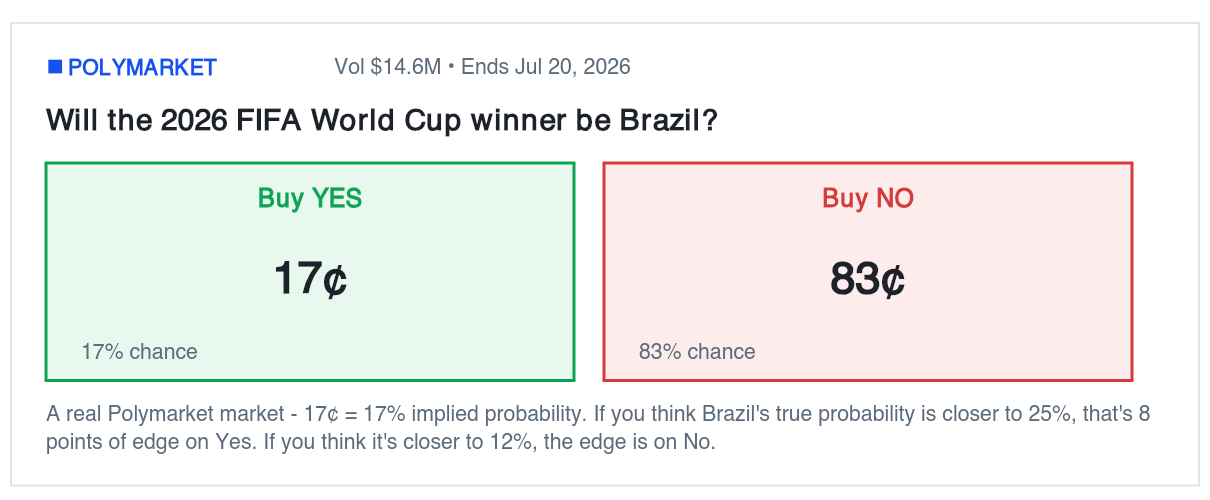
We covered the basic translation in Chapter 3 — price equals probability. Now we go deeper. The Polymarket price you see at any moment is not just "what the market thinks today." It is the marginal opinion of the most recent buyer or seller, weighted by the depth of the order book around it. Learning to read that detail is the difference between guessing and trading.
The mid price vs the order book
Every market shows a Yes price and a No price at the top of the screen. Click into the order book and you'll see the actual bids (buy orders) and asks (sell orders) stacked at different prices. The midpoint between the best bid and the best ask is the "mid" — the cleanest single estimate of the current fair price.
If you click the buy button, you do not trade at the mid. You trade at the lowest ask — and if your size is larger than what's offered at that price, you walk up the book and your average fill price moves against you. This is called slippage, and it is one of the biggest hidden costs for beginners. We cover defenses in Chapter 7.
How prices move
Polymarket prices move for three reasons:
- New information. A poll drops, a player gets injured, the Fed signals a hold. The market reprices to reflect what everyone now knows.
- Flow. A large trader takes one side aggressively, eating through liquidity and shifting the mid.
- Time. As resolution approaches, uncertainty collapses. Prices drift toward $1.00 or $0.00 depending on which side looks like it will win.
A skilled trader does not just react to the price — they ask why the price is where it is. Is this an information move (probably correct) or a flow move (often an opportunity to take the other side)?
The chart, in plain English
Polymarket's market detail page shows a price-over-time chart. A line at 0.50 that drifts to 0.80 over two weeks tells a story: the Yes side has been winning the news cycle. Sharp single-bar spikes usually mark individual catalysts — a debate, a court ruling, an ETF filing. Hover the chart to see exact prices and timestamps.
Chapter 06
Placing Your First Trade
Small. Slow. Considered. The way you place your first ten trades will set the habits that govern your next ten thousand.
The eight-step trade checklist
- Pick a market you understand. If you cannot explain the resolution rule out loud in one sentence, stop.
- Read the resolution source. Every market has an official source (e.g., "AP race call" or "CoinGecko closing price"). Know it.
- Check the end date. Capital is tied up until resolution — that is a real cost.
- Form your own probability estimate. Write it down before looking at the price.
- Compare to the market. If your number is at least 5–10 percentage points away, you may have edge.
- Decide your size. Use the position-sizing rules in Chapter 8. Never just "feel" your size.
- Choose order type. Limit orders if liquidity is thin; market orders only when the spread is tight and you need speed.
- Submit and screenshot. Take a screenshot of the trade and your reasoning. Reviewing your old reasoning is how you actually improve.
A worked example
Suppose Polymarket lists "Will the Federal Reserve cut rates at the next FOMC meeting?" You read the FOMC statement and minutes from the previous meeting, scan the latest CPI and jobs prints, and check the CME FedWatch tool. You estimate the true probability of a cut at 70%. Polymarket's Yes is trading at $0.58. That is a 12-point edge in your favor.
You decide to risk 2% of your bankroll on the trade — say, $200 of a $10,000 account. You place a limit buy for Yes at $0.58, sized so the total cost is around $200. If the Fed cuts and Yes resolves to $1.00, you make about $145. If they don't, you lose your $200. Over enough trades where your edge is real, you come out ahead.
Chapter 07
Order Types, Liquidity & Slippage
Every dollar you save on execution is a dollar that compounds. Pros treat order placement as a skill, not a formality.
Market vs limit — the only two orders that matter
A market order says "fill me right now at the best available price." It guarantees execution but not price. A limit order says "only fill me if the price is X or better." It guarantees price but not execution.
Beginners default to market orders out of impatience — and bleed money. Pros default to limit orders, post their bid into the order book, and wait for the market to come to them. The only times to use a market order are: (a) when the spread is one or two cents and you need a fast fill, or (b) when you are exiting a losing position fast.
Liquidity, depth, and spread
Liquidity is how much size can trade without moving the price much. You see it three ways:
- Spread: the gap between the best bid and best ask. A tight spread (1–2 cents) is healthy. A wide spread (10+ cents) means the market is illiquid.
- Depth: how much volume sits at each price level. A market with $50,000 stacked at the top of the book is very different from one with $50.
- Daily volume: shown on the market page. Markets with low volume are often mispriced — but also harder to exit.
Slippage: a worked example
Imagine the order book for a market looks like this: 200 shares offered at $0.40, 500 shares at $0.42, 1,000 shares at $0.45. If you place a market order for 1,000 shares, your average fill is roughly $0.43 — not the $0.40 you saw at the top of the book. That extra $0.03 per share is slippage. On a 1,000-share order, that's $30 lost on entry alone.
The fix is simple: use a limit order at $0.40, only buy what's available, and post a second limit at $0.41 if you still want more. Be patient — your fill rate on limit orders is your edge.
Chapter 08
Risk Management & Position Sizing
The only traders who survive long enough to get good are the ones who never blew up while learning. Sizing is how you stay in the game.
The bankroll mindset
Treat your Polymarket balance as a bankroll, not a checking account. Decide upfront how much money you are willing to lose entirely without changing your life. That number is your bankroll. Everything you do is sized as a percentage of it.
If you have $5,000 you can afford to lose, your bankroll is $5,000. Never deposit money you cannot afford to lose. Never chase losses by topping up. The bankroll is fixed; the strategy is what flexes.
The 1–3% rule
Risk no more than 1–3% of your bankroll on any single trade. On a $5,000 bankroll, that is $50 to $150 of risk — meaning the maximum you lose if the position goes to zero. For a Yes share bought at $0.20, your risk per share is $0.20, so 1% of bankroll allows about 250 shares. For a Yes share at $0.80, risk per share is $0.80, so 1% allows just over 60 shares.
This rule sounds boring. It is the single most important thing in this book. A trader risking 20% per position needs only five bad trades in a row to be wiped out. A trader risking 2% per position can survive 20 bad trades in a row and still have most of their bankroll intact.
If you want these numbers turned into a concrete allocation for your own bankroll and risk tolerance, use the free Polymarket trading plan builder — eight questions, no account, and it outputs a position-sizing framework and risk rules you can start with.
The Kelly criterion (advanced, optional)
If you want to size more aggressively when you have strong edge, study the Kelly criterion. The simplified formula for binary bets is: fraction = (p × b − q) / b, where p is your estimated probability of winning, q is 1 minus p, and b is the payoff per dollar risked. Most pros use "fractional Kelly" — half or quarter Kelly — to smooth volatility. If the math gives you a negative number, do not take the trade.
Chapter 09
Market Resolution & Disputes
Every market eventually ends. Knowing how it ends is just as important as knowing how it started.
How resolution works
Each Polymarket market has a written resolution rule and a designated data source. When the underlying event occurs, the market is resolved by the UMA Optimistic Oracle — a decentralized protocol that lets anyone propose the outcome. If no one disputes within the challenge window (typically 1–2 hours for clear-cut markets, longer for ambiguous ones), the proposed outcome stands and shareholders are paid out.
If someone disputes the proposed outcome — claiming, for example, that the resolution source is being misread — the dispute escalates to UMA token-holder voting. Disputes are rare in clear markets and common in fuzzy ones, which is why beginners should heavily favor markets with obvious resolution criteria.
Reading the resolution rule
Before placing any trade, click "Resolution Details" or scroll to the bottom of the market page. Read every word. Pay attention to:
- Source: who decides? AP, CoinGecko, the official scoreboard, the candidate's own statement?
- Cutoff time: exact UTC timestamp at which the answer is locked in.
- Edge cases: what happens in a tie, in a postponement, if the source goes offline, if the event is canceled?
- Tiebreakers: some markets specify "if no resolution by date X, market resolves No" — these can be a hidden trap.
Cashing out before resolution
You do not have to hold a position until the market resolves. You can sell back into the order book at any time. This is enormously useful: it lets you take profit when news moves the price your way, cut losses when you are wrong, and free up capital for better opportunities. The same rules apply when selling — use limit orders, mind the spread.
Chapter 10
Ten Beginner Mistakes That Bleed Bankrolls
The fastest way to get good is to skip the expensive lessons that other traders already paid for.
1. Trading the headline, not the resolution rule
You read "Will the President do X?" and assume it means the obvious thing. The resolution criteria say something subtler. Always read the fine print before sizing up.
2. Using market orders in illiquid markets
You see Yes at $0.20 and click buy. Your fill comes back at $0.27. The spread ate 35% of your edge before the trade even started.
3. Overweighting tiny markets
A market with $5,000 of total liquidity is not where to put $2,000. Even a small player on the other side will move the price against you.
4. Falling in love with a position
You bought Yes at $0.40 because you were sure. The price is at $0.18 and "new evidence" makes you double down. Most of the time, the market knew something you didn't. Re-evaluate the trade as if you didn't already own it.
5. Ignoring time decay on long-dated markets
A $0.10 ticket that resolves in eight months is not the same bet as a $0.10 ticket that resolves tomorrow. Capital tied up has an opportunity cost and a psychological cost.
6. Confusing volume with edge
A trending market is not necessarily a mispriced market. The biggest Polymarket markets are watched by the sharpest traders. The edge is often in mid-volume markets where the crowd is smaller.
7. Trading personal politics
You think your candidate is going to win. Your prior is biased. The market is the aggregate opinion of thousands of people with money on the line. If you cannot explain why you disagree with the market without saying "I just feel like…", you do not have an edge.
8. Skipping position sizing
Going "all in" on a 90% favorite seems like easy money. Then it loses, and the bankroll is gone. The 10% that hits when you least expect it is what destroys un-sized traders.
9. Chasing losses
After a losing day, doubling size to "win it back." This is the single fastest way to ruin. The market does not owe you a comeback.
10. Not tracking trades
If you cannot answer "what was my hit rate this month?" you cannot improve. Keep a simple spreadsheet — date, market, side, size, entry, exit, P&L, reason. Review it weekly.
Chapter 11
Edge — Expected Value, Fair Value & Smart Money
Three concepts separate the consistent winners from everyone else. They all answer the same question: where is the mispricing?
Expected value (EV) in one minute
Expected value is the average outcome of a trade if you could play it thousands of times. The formula for a binary Polymarket trade is:
EV = (your true probability × ($1 − entry price)) − ((1 − your true probability) × entry price)
Positive EV means the trade is profitable on average. Negative EV means you are paying the market more than your edge is worth.
Example: you buy Yes at $0.40 and you believe the true probability is 55%. Your EV per share is (0.55 × 0.60) − (0.45 × 0.40) = 0.33 − 0.18 = $0.15. That is a 37.5% EV on your entry — excellent. Repeat that math over hundreds of trades and you get a profitable career.
The hard part is the true probability, not the arithmetic. For a practical walkthrough of where mispricings actually hide, see the guide on finding mispriced Polymarket markets, and for using wallet track records as confirmation, see tracking smart money. If you would rather lean on traders who already do this work, the guide to copy trading on Polymarket compares every bot and tool available and covers the risks of each.
Fair value — the price you'd pay with perfect info
Fair value is the price the market should be at, given everything knowable today. Computing fair value rigorously is hard. It involves weighing base rates, adjusting for new information, modeling time decay, and accounting for selection effects. Most retail traders skip this step entirely — which is exactly why an edge exists for those who do it.
Building your own fair-value model requires statistics, data plumbing, and discipline. The good news: you do not have to build it yourself. TrueOdds maintains a continuously updated fair-value engine that scrapes official data sources (Federal Reserve releases, NOAA weather, NASA feeds, league stats, on-chain metrics, and more) and runs every active Polymarket market through a probability model. The output is a single number per market: the True Fair Value, alongside the divergence from the current price.
Smart money — following the wallets that win
On a centralized sportsbook, you have no way to know what the sharpest bettors are doing. On Polymarket, every trade is on-chain, every wallet is public, and the "sharps" reveal themselves through their P&L. Smart-money tracking — watching which wallets consistently win and how they are positioned in active markets — is one of the most powerful edges a Polymarket trader can have.
Tracking it manually is brutal. You'd need to index thousands of wallets, compute their realized P&L over months, classify them by skill tier, and cross-reference their positions against today's open markets. TrueOdds does this for you and surfaces it as Whale Radar — a live view of where the proven winners are placing their chips. We'll go deep on it in the next chapter.
The trader's mantra
A real edge is the intersection of two things: (1) a price that diverges meaningfully from fair value, and (2) confirmation from independent sources — your own analysis, smart-money positioning, or both. Trades that satisfy both conditions are rare. They are also where almost all of your profit will come from.
Chapter 12
TrueOdds — Your Edge in One Dashboard
If you've ever lost money on Polymarket and wondered what the people who consistently win actually see… this is what they see.
Why TrueOdds exists
Polymarket is the most honest market on the internet. It is also brutally competitive. Most retail traders lose — not because the platform is rigged (it isn't), but because they show up with hype, headlines, and gut feel while a tiny minority of sharp wallets quietly run probability models, index on-chain flow, and feast on every mispriced contract the crowd offers them.
TrueOdds was built to flip that script. We took the toolkit the pros spent years cobbling together — probability models, smart-money indexing, signal classification, and live mispricing alerts — and packaged it into a single dashboard you can read in five focused minutes a day. You don't need to be a quant. You don't need to write code. You don't need to babysit blockchain explorers at 3 a.m. You just need to log in, look at what the system surfaces, and trade the spots where data, models, and on-chain flow all line up in your favor.
Under the hood: two engines, running 24/7
Layer 1 — The AI Probability Engine. TrueOdds continuously ingests data from the world's most authoritative public sources: Federal Reserve releases for macro markets, NOAA and NASA feeds for weather and natural-event markets, official league APIs for sports, real-time on-chain metrics for crypto markets, polling aggregators for politics, and dozens more. For every active Polymarket market, the engine computes a True Fair Value — the probability we believe is closer to ground truth than the current market price.
Layer 2 — Whale Radar (Smart Money Tracker). Every Polymarket trade is on-chain, which means every wallet's track record is public — if you have the infrastructure to index it. We do. TrueOdds indexes thousands of wallets, scores them by realized profitability over months and years, classifies them into tiers (Shark, Professional, Gambler), and tracks their positions across every active market. When a top-tier wallet enters a market in size, the system flags it instantly. When their position aligns with our fair-value model, you are looking at the highest-conviction signal on the platform.
On top of that, we built our own proprietary Smart Money Index and we display it on every single market. It rolls up exactly how much of the smart-money capital on a market is sitting on YES vs NO, so you can filter the entire Polymarket universe down to the markets where the sharpest wallets have already taken a side.
Smart Traders — the live wallet feed
Open the Smart Traders tab on the TrueOdds dashboard and you are looking at the live, real-time feed of every meaningful trade placed by the wallets we have classified as winners. Each card shows you the exact size of the trade in dollars, which side was hit (BUY YES, BUY NO, SELL YES, SELL NO), the entry price, how long ago the trade happened, the trader's track record, and their lifetime PnL. WINNER and SMART TRADER badges flag the tier of the wallet placing the bet.
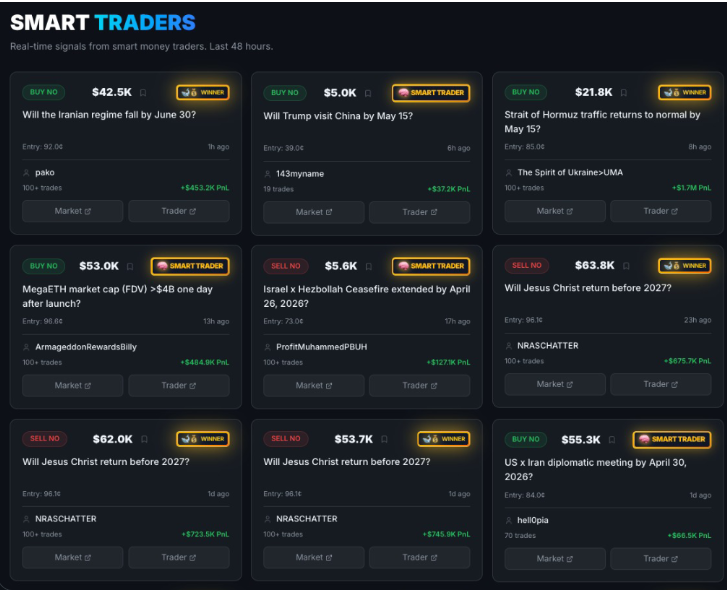
Two clicks from any card take you straight to the underlying Polymarket market or to the trader's full profile so you can audit their history before mirroring the trade. Used disciplined, this is the highest-leverage 60 seconds of your trading day — one scroll tells you where the smartest money on the platform is moving right now.
The signal taxonomy — exactly what each one means
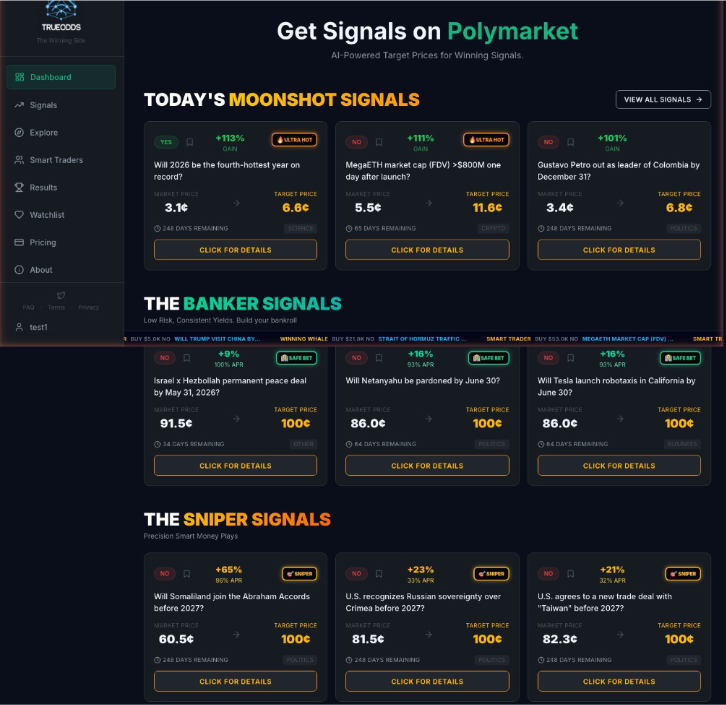
Every signal we publish falls into one of five buckets. Pick the buckets that match your risk appetite and ignore the rest. The labels are not marketing fluff — each category has its own characteristic hit rate, average payout multiple, and recommended position size.
| Signal | What it is | Best for |
|---|---|---|
| MOONSHOTS | High-risk, high-reward markets where our fair value diverges sharply from the price. Big payoff, accept higher loss rate. | Aggressive traders comfortable with variance. |
| BANKERS | Safer, high-probability plays with attractive APR until resolution. Smaller individual wins, but consistent. | Risk-conscious traders building a base. |
| SNIPER | Precision plays where smart-money positioning aligns with our fair-value target. Highest-conviction signals on the platform. | Traders who want the very best ideas only. |
| SMART MONEY | Markets where proven professional wallets are heavily positioned. Follow the people who keep winning. | Anyone who wants to ride the sharps. |
| SWING | Markets resolving within 10 days where smart money is clearly on one side. Fast turnaround, high volatility, so set a limit order and take profits. | Traders who want quick cycles instead of waiting months. |
The Analyze tool — your one-click second opinion
This is the feature that changes how you trade. The workflow is absurdly simple. You are scrolling Polymarket. You see a market that catches your eye. Before you click buy, you copy the URL, switch to TrueOdds, and paste it into the Analyze input.
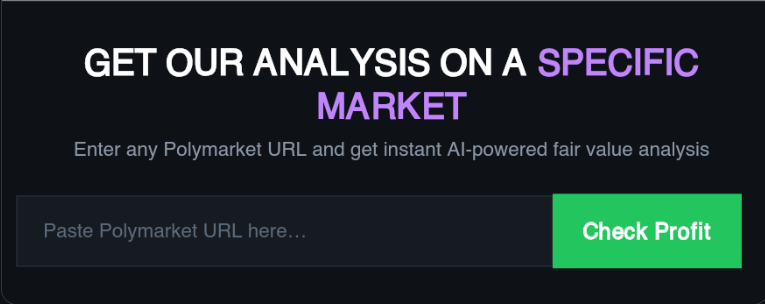
Within seconds the dashboard shows you:
- The current market price on both Yes and No sides.
- The TrueOdds True Fair Value — what we believe the price should be.
- The divergence between the two, and whether it is large enough to be actionable.
- The target price the market would have to reach for the trade to make sense.
- Smart-money positioning on this exact market — how many top-tier wallets are in, on which side, and in what size.
- Plain-English reasoning — the AI explains exactly which factors moved its number, so you can pressure-test the thesis instead of trusting a black box.
A real Analyze result, end to end
Sample market: Will Somaliland join the Abraham Accords before 2027? The market is trading at 62.5 cents on YES. Our engine targets 100 cents on NO — a 60% gap — and 98% of the smart money on the platform is already positioned NO. The reasoning panel walks you through the diplomatic base rates, current geopolitical signals, and the model's confidence interval.
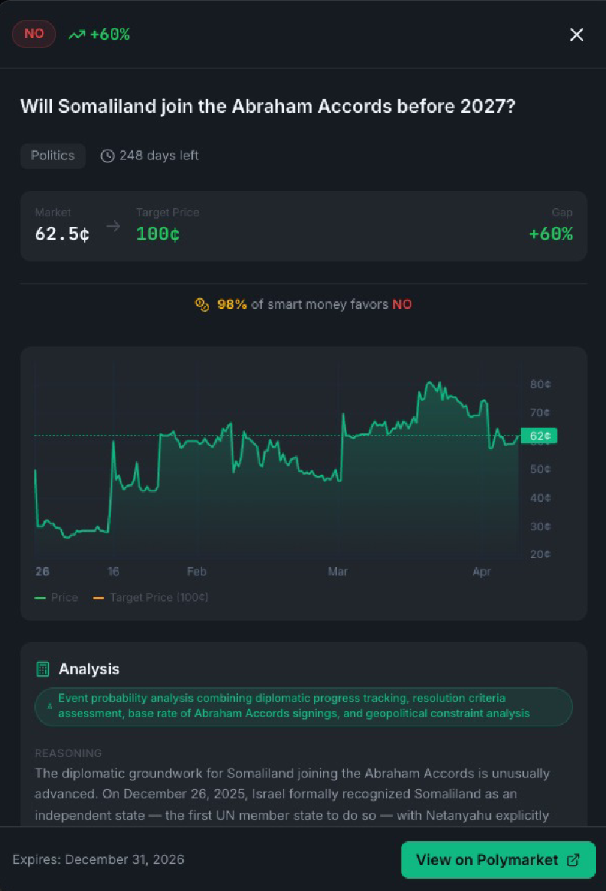
If the divergence is small, you walk away. No trade, no money lost on a bad idea. If the divergence is large and smart money agrees with our model, you size the position correctly and place the trade with conviction. The Analyze tool is the difference between trading on vibes and trading on data, and it lives one paste away from every Polymarket market on the planet.
Explore Markets — the entire Polymarket universe, filtered
Polymarket lists tens of thousands of active markets at any given time. Most of them are unprofitable noise. Explore Markets is the tool that gets you from "there are 32,000+ markets" to "here are the 12 worth my attention right now." Filter by liquidity (skip markets too thin to trade), price range (longshots, mid-range, or high-probability), time-to-resolve, and category (Politics, Crypto, Sports, Science, Business, Pop Culture, AI, or Other). Sort by liquidity, volume, time, or our internal divergence score. The result is a clean, sortable table that turns the firehose into a watchlist candidate pool you can actually work through.
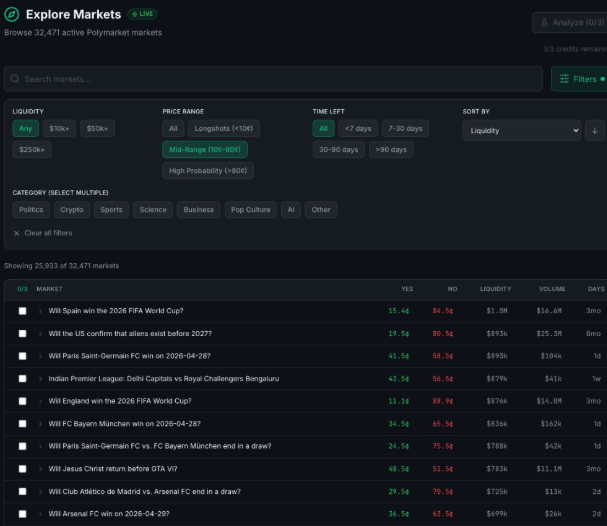
Watchlist + Smart Trader alerts
Add the markets you care about to your TrueOdds watchlist and the system watches them for you. The instant something changes — a new high-conviction signal goes live, a top-tier wallet enters a position, or our fair-value estimate diverges far enough from the price to open an actionable edge — you get notified. No more refreshing pages every ten minutes.
You can also follow specific Smart Traders directly. If you have identified a wallet that consistently wins, follow it. The next time they place a position above your configured size threshold, you'll know within minutes — and you can decide whether to ride along.
The private community — trade alongside other members
Tools are only half the edge. The other half is the people you trade with. Every TrueOdds member gets access to a private community chat where you can post setups, ask for a second opinion before you size into a position, share Smart Trader wallets you have started following, and crowdsource resolution-rule edge cases. The room is moderated to keep noise out and the operators jump in regularly with context on the day's signals.
A day in the life of a TrueOdds member
- Morning (5 minutes). Open the dashboard with your coffee. Scan today's Banker signals. Scan the Sniper feed. Add anything interesting to your watchlist.
- Pre-trade (1 minute per market). Found a market on Polymarket you're tempted by? Paste the URL into Analyze. If the divergence is meaningful and smart money agrees, take the trade with proper sizing. If not, pass without regret.
- During the day. Alerts ping you when watchlist markets shift, when high-tier wallets enter a position, or when a new high-conviction signal fires.
- Weekly (15 minutes). Skim the Results page. See which signal types are running hot in the current macro environment and tilt your daily attention accordingly.
The promise
TrueOdds will not turn every trade into a winner. Nothing can, and anyone who tells you otherwise is selling you a fairy tale. What TrueOdds will do is dramatically tilt your average trade away from the crowd's outcome and toward the outcome of the people who consistently win. Used alongside the discipline you have built through this guide — proper sizing, limit orders, edge-only trading — it is the shortest path from curious beginner to consistently profitable Polymarket trader.
Chapter 13
Glossary & Resources
Bookmark this chapter. The vocabulary is the first thing that separates a confident trader from a confused one.
| Term | Meaning |
|---|---|
| APR | Annualized Percentage Rate. On Polymarket, the implied yield of a Banker-style position calculated to the resolution date. |
| Ask | The lowest price at which someone is willing to sell a share. You buy at the ask. |
| Bankroll | The total pool of money you have set aside for trading. Should be money you can afford to lose. |
| Base rate | The historical frequency of an event occurring. The starting point for any fair-value estimate. |
| Bid | The highest price at which someone is willing to buy a share. You sell at the bid. |
| Binary contract | A contract that pays $1 if the answer is Yes and $0 if the answer is No (or vice versa). Polymarket markets are binary. |
| CFTC | The US Commodity Futures Trading Commission. Polymarket operates a CFTC-regulated entity for US users as of November 2025. |
| Edge | The difference between your estimated probability and the market's price. Positive edge is what you're hunting for. |
| EV (Expected Value) | The average profit or loss of a trade if you could repeat it indefinitely. Positive EV trades are the only kind worth taking. |
| Fair value | The probability the market should be priced at, given everything knowable today. TrueOdds computes this for you. |
| Fill | An executed trade. A "partial fill" means only part of your order was matched. |
| KYC | Know Your Customer — identity verification required for regulated US trading on Polymarket. |
| Limit order | An order that only executes at a specified price or better. The default tool of a disciplined trader. |
| Liquidity | How much volume can trade without moving the price much. High liquidity = tight spreads and depth. |
| Market order | An order that fills immediately at the best available price. Fast but expensive in illiquid markets. |
| Mid price | The midpoint between the best bid and the best ask. The cleanest estimate of current fair price. |
| No share | A share that pays $1 if the market resolves No and $0 if it resolves Yes. |
| On-chain | Recorded directly on the blockchain. Polymarket trades and balances are on-chain on Polygon. |
| Order book | The list of unfilled buy and sell orders at every price level for a given market. |
| Polygon | An Ethereum-compatible blockchain optimized for fast, cheap transactions. Polymarket runs on it. |
| Position | Shares you currently own in a market. Open positions live in your portfolio until you close them or the market resolves. |
| Resolution | The process of settling a market based on the real-world outcome and paying out winners. |
| Slippage | The difference between the price you expected and the average price your order actually filled at. |
| Smart money | Wallets with a long, verifiable track record of profitable trading. TrueOdds tracks them automatically. |
| Spread | The gap between the best bid and the best ask. Narrow = healthy market; wide = thin market. |
| UMA Optimistic Oracle | The decentralized protocol Polymarket uses to confirm market outcomes. |
| USDC | A US-dollar-backed stablecoin. The currency in which Polymarket trades and pays out. |
| Yes share | A share that pays $1 if the market resolves Yes and $0 if it resolves No. |
Resources & next steps
- TrueOdds dashboard — trueodds.win — your daily home for signals, Smart Traders feed, Analyze, Explore Markets, watchlist alerts, and the private community chat.
- TrueOdds on X — @TrueOdds_Poly for live calls and education.
- Polymarket — polymarket.com — opens your account through our partner link, which costs you nothing and helps us keep this guide free.
- Your trade journal — a simple spreadsheet of every trade you take. The single best self-improvement tool you have.
One last thing
Prediction markets reward patience, discipline, and process. They punish ego, impatience, and chasing. Manage your size. Cut your losses. Read every resolution rule. Let TrueOdds do the heavy data work so you can focus on the only thing that actually matters: making good decisions, one trade at a time.
Ready?
Step onto The Winning Side
Use our partner link to create your Polymarket account in two minutes — then open the TrueOdds dashboard and put every principle in this guide to work.
Educational content only. Nothing in this guide is financial, investment, or legal advice. Trading prediction markets carries risk, including the risk of total loss. Trade only with money you can afford to lose, and verify regulatory eligibility in your jurisdiction.