Fair value
How to Find Mispriced Markets on Polymarket
4 min readBy TrueOddsUpdated
What you will learn
- Why a market price is just a probability, and when it is wrong
- The three places mispricings hide (and where they never do)
- How to use fair value and smart money as a two-step confirmation
What a mispriced market actually is
Every price on Polymarket is a probability in disguise. When a market shows YES at 62 cents, the crowd is saying the event has roughly a 62 percent chance of happening. Buy YES and you pay 62 cents for a contract that pays out 1 dollar if the event resolves YES.
A market is mispriced when your best estimate of the true probability, its fair value, is meaningfully different from that number. If you believe the real chance is 75 percent but the market prices it at 62, the YES side looks underpriced. That gap between price and fair value is the whole game.
| Market price (YES) | Implied probability | Your fair value | Read |
|---|---|---|---|
| 62c | 62% | 75% | YES looks underpriced |
| 40c | 40% | 25% | NO looks underpriced |
| 88c | 88% | 88% | Fairly priced, no gap |
Finding these gaps by hand across thousands of live markets is the hard part. The rest of this guide is about where to look and how to be confident the gap is real.
Where mispricings hide (and where they never do)
The most visible markets, the ones sorted to the top by volume with hundreds of comments and constant coverage on X, are the least likely to be mispriced. They have been picked over. Every obvious read has already been taken and priced in.
The markets worth your time usually share three traits:
- Enough liquidity to enter and exit without heavy slippage.
- A clear, verifiable resolution rule with a defined deadline.
- Less attention than their importance deserves.
A practical tip: sort by open interest rather than raw volume. Open interest shows how much money is currently committed to a market, which surfaces markets that attracted capital without attracting constant monitoring.
The three patterns that create mispricings
1. Information lag
The most common and most time-sensitive pattern. Public information exists that should move a price, but the market has not processed it yet. On high-attention markets this window is often 30 seconds to a few minutes. On quieter markets it can last hours.
2. Headline-versus-resolution gaps
Most people read the headline and trade the headline. When the actual resolution criteria are more specific than the title suggests, the price reflects the headline rather than the real conditions. Reading the rules carefully is one of the few repeatable ways to see what the crowd missed.
3. Thin attention
Important but unglamorous markets that few people are actively watching drift away from fair value simply because nobody is correcting them.
How to estimate fair value
Fair value is your independent estimate of the true probability. A few grounded ways to get there:
- Compare to outside sources. Independent probability estimates from forecasting communities, polling aggregates, or domain data give you a reference point. When they diverge meaningfully from the market, look closer.
- Start from base rates. How often does this kind of event actually happen historically? Anchor there, then adjust for the specifics.
- Separate the signal from the noise. Short-term price swings on a headline are often noise. The question is whether the new information changes the underlying probability, not whether it moved the price for five minutes.
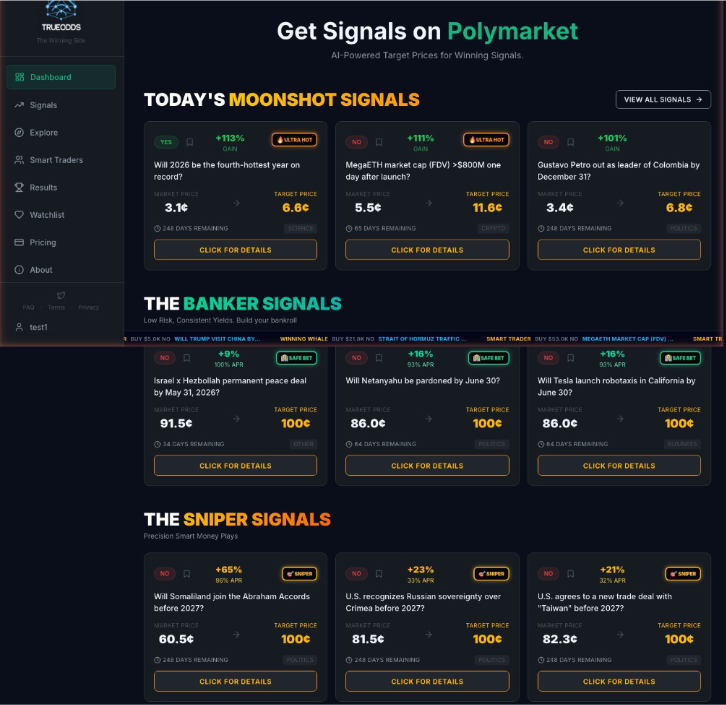
This is exactly the work an analytics tool can do at scale. TrueOdds runs an AI fair-value model on every Polymarket market, reads the resolution rules and current context, and reports the gap to target for you.

A repeatable two-step check before you enter
A single opinion, even a good one, is not enough. The most reliable approach is to require two independent reasons to agree before you act:
- Fair value gap. The model estimate is meaningfully higher than the market price on one side.
- Smart money confirmation. The most profitable wallets in that market are positioned on the same side as the gap.
When both line up, you are no longer trading on a hunch. When they disagree, that is a signal to slow down and reread the resolution rules. Smart money is a second opinion, never the whole reason. Our companion guide, Polymarket Smart Money, covers how to read it properly.
Related guides
Educational content only. Nothing in this guide is financial, investment, or legal advice. TrueOdds is a research and analytics tool. Prediction markets carry risk of loss. Past performance does not predict future results.