Strategy
How to Build a Polymarket Trading Strategy
4 min readBy TrueOddsUpdated
What you will learn
- How to match market types to your risk tolerance and availability
- A four-step pre-entry check used before every trade
- The risk rules that keep one bad market from wrecking your month
A strategy is a repeatable process, not a hot take
Most people on Polymarket do not have a strategy. They have opinions and a wallet. A real strategy answers four questions the same way every time: which markets you trade, how you decide to enter, how much you commit, and when you exit. Write those down and you have something you can repeat and improve. Wing it and every trade starts from zero.
This guide builds that process in three parts: match, check, and protect.
Step 1: Match market types to your risk and time
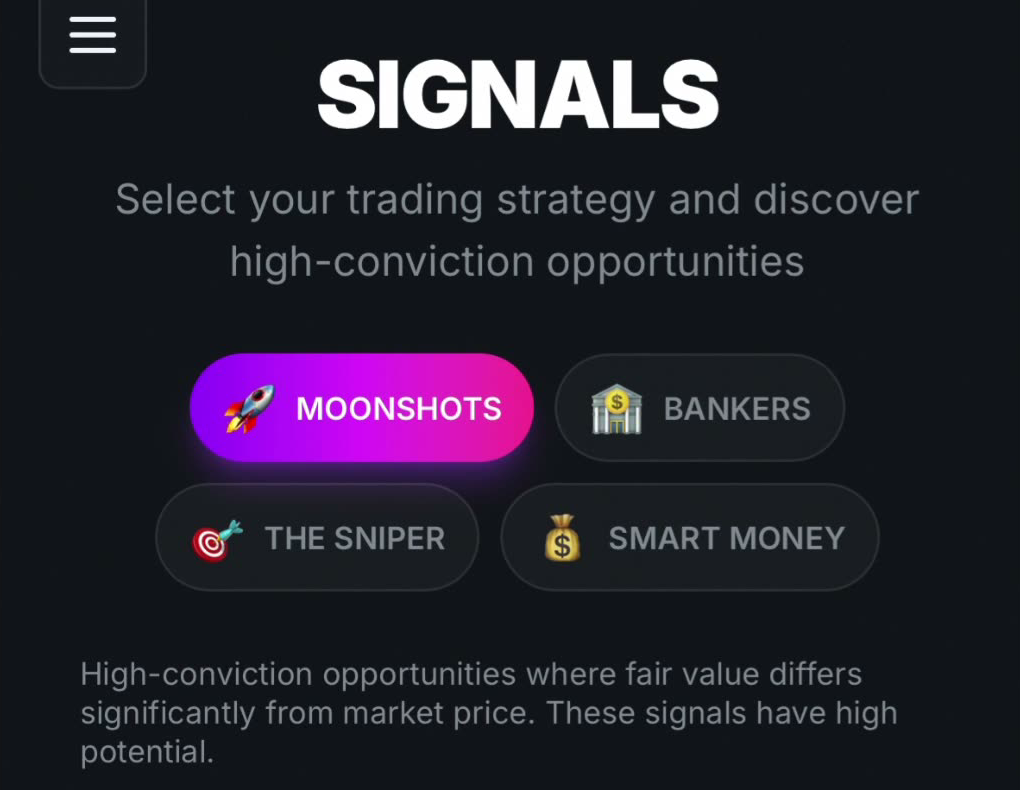
Not every market suits every trader. The right mix depends on how much risk you are comfortable with and, just as importantly, how often you can actually be at the screen. Five broad types cover most of what you will trade:
| Type | What it is | Hit rate (historical) | Exit |
|---|---|---|---|
| Banker | High-probability markets close to resolution | About 9 in 10 | Hold to resolution |
| Sniper | Model read and smart money on the same side | About 2 in 3 | Hold to resolution |
| Smart Money | Where the most profitable wallets concentrate | Mixed by market | Depends on the setup |
| Moonshot | Asymmetric swings, big gaps to fair value | About 1 in 3 | Take profit on the spike |
| Swing | Resolving within 10 days, smart money clearly on one side | New category | Limit order, take profits |
Hit rates are working estimates based on historical signal price action and vary by market conditions. They are not a guarantee of future results.
The time factor is decisive. Moonshots need you present to take the exit on the spike. Held to resolution they often give it all back. If you can only check in during the evening, a conservative mix built around Bankers and Snipers fits your life far better than a book full of Moonshots you cannot manage.
Step 2: The four-step pre-entry check
Run every candidate trade through the same four steps before you commit a cent.
- Analyze. Look at fair value, the current news, and the smart money split on the market. Know what you think it is worth and why.
- Look for double confirmation. A model read plus a whale, smart money, or a proven trader on the same side. Two independent reasons beat one strong opinion.
- Decide with a target. Set your take profit and stop loss before you enter, not after. Deciding your exit while you are already in the trade is how discipline dies.
- Keep monitoring. Track the markets and traders you care about until you exit. Alerts do this for you so you are not glued to the screen.
Step 3: Set your risk rules before you enter
A good process still fails without guardrails. These rules keep one bad market from wrecking a month of careful work:
- Hard per-trade cap. Size any single position at a small fixed share of your capital. For volatile Moonshots, keep it tight and take the exit on the spike.
- One event, one exposure. Never stack several correlated positions on the same underlying outcome. It feels like three trades and behaves like one.
- Let the slow ones resolve. Bankers and Snipers are meant to run to resolution. No panic exits on a normal wobble.
- Whales confirm, they do not decide. Copied flow and the smart money reading are inputs to your check, never the entire reason for a trade.
- Weekly review by type. Once a week, look at which category is working for you and which is costing you. Adjust the mix, not your discipline.
Turn it into a personal plan
Matching types to your profile, running the four-step check, and holding to your risk rules is the whole strategy. The only hard part is doing it consistently. That is what the TrueOdds Plan Builder automates: it asks eight quick questions about your experience, risk tolerance, availability, and capital, then produces a personalized allocation across the signal types, a screener recipe to find matching traders, and a set of risk rules built for your profile.
New to the mechanics of prices, orders, and resolution? Start with the Polymarket Playbook first, then come back and build your plan.
Related guides
Educational content only. Nothing in this guide is financial, investment, or legal advice. TrueOdds is a research and analytics tool. Prediction markets carry risk of loss. Past performance does not predict future results.