Smart money
Polymarket Smart Money: How to Track Profitable Traders
7 min readBy TrueOddsUpdated
What you will learn
- What actually separates smart money from the crowd (PnL and trade history)
- The exact thresholds that sort wallets into sharks, professionals and gamblers
- How position weighting turns raw wallets into a single smart money split
- How to track profitable Polymarket wallets yourself
- Why smart money is a confirmation input, never the whole reason
What smart money means on Polymarket
Smart money is shorthand for the traders whose track record says they usually know what they are doing. On Polymarket, every position sits on the public Polygon blockchain, which means anyone can see who holds a market and how those wallets have performed over time.
The useful idea is simple: when a market is heavily held by wallets with strong, consistent histories, their side is worth a second look. When it is held mostly by wallets that lose, the crowd reading is weaker than it appears. Smart money turns that public data into a read on who is positioned, not just how many.
How to tell smart money from noise
Not every large wallet is smart, and not every small one is dumb. Two numbers do most of the work of separating signal from noise:
- All-time profit and loss. A wallet that is up over many markets has shown something a single lucky hit cannot.
- Trade count. A track record needs a sample. A wallet with hundreds of resolved trades is more informative than one with three.
Combining the two lets you sort holders into tiers. Wallets that make markets or provide liquidity, with effectively zero directional trades, are excluded because they are not taking a view:
Combining the two lets you sort holders into tiers. These are the exact thresholds TrueOdds uses, published in full so you can apply them yourself or disagree with them:
| Tier | All-time profit | Lifetime trades | Weight |
|---|---|---|---|
| Shark | Over $10,000 | Over 50 | 10 |
| Professional | Over $2,000 | Over 20 | 3 |
| Gambler | Everything else | Any | 0 |
Both conditions have to hold. A wallet up $40,000 across four trades is variance wearing a costume, so it does not clear the shark bar. That is the entire point of pairing profit with trade count: it filters out the wallets that got lucky loudly.
Wallets with zero lifetime trades are excluded outright. Those are liquidity providers and market makers whose inventory is a by-product of quoting both sides, not a directional view. Counting them would add noise to every market they touch.
Weighting each holder by both quality and position size gives you a picture of how the informed money is leaning, rather than a raw headcount that a hundred small wallets could swing.
How the split is actually calculated
Tiers on their own are not enough. A market held by one shark and forty gamblers is very different from one held by forty sharks, and a shark holding $50 is not the same as a shark holding $50,000. The fix is to weight every holder by both their tier and the size of their position.
For each side of a market, take every holder's position size, multiply it by their tier weight, sum those, and divide by the total position on that side. That gives a position-weighted quality score for the side. Normalize it onto a 0 to 100 scale, then express each side as a share of the two:
- Weighted average per side = sum(position x tier weight) / total position, rescaled to 0-100.
- YES smart money share = YES weighted average / (YES weighted average + NO weighted average), as a percentage.
- NO smart money share = 100 minus the YES share.
The consequence worth internalizing: a market can be 80% gamblers by headcount and still read as heavily smart-money YES, because one shark with a large position outweighs a crowd of small wallets. That is the intended behaviour. It is also why the split moves when a single proven wallet takes a real position, and barely moves when fifty small accounts pile in.
How to track Polymarket wallets yourself
None of this requires a tool. Polymarket settles on a public blockchain, so every input is readable if you are willing to do the work. The manual version:
- 1. Pull the holders of a market. Polymarket exposes the wallets holding each side of a market, along with their position sizes.
- 2. Map each holder to a side. A market has two outcome tokens. Which token a wallet holds determines whether they are on YES or NO.
- 3. Look up each wallet's record. For every holder, read their all-time profit and their lifetime trade count. Both are public.
- 4. Apply the thresholds. Sort each wallet into shark, professional or gambler using the table above, and drop anyone with zero trades.
- 5. Weight and total. Run the position-weighted math above to get a single split for the market.
The catch is scale. Doing this by hand for one market you already care about is a reasonable afternoon. Doing it across every active market, refreshed as positions change, is not, which is the whole reason the indicator exists as a product.
Reading the smart money split
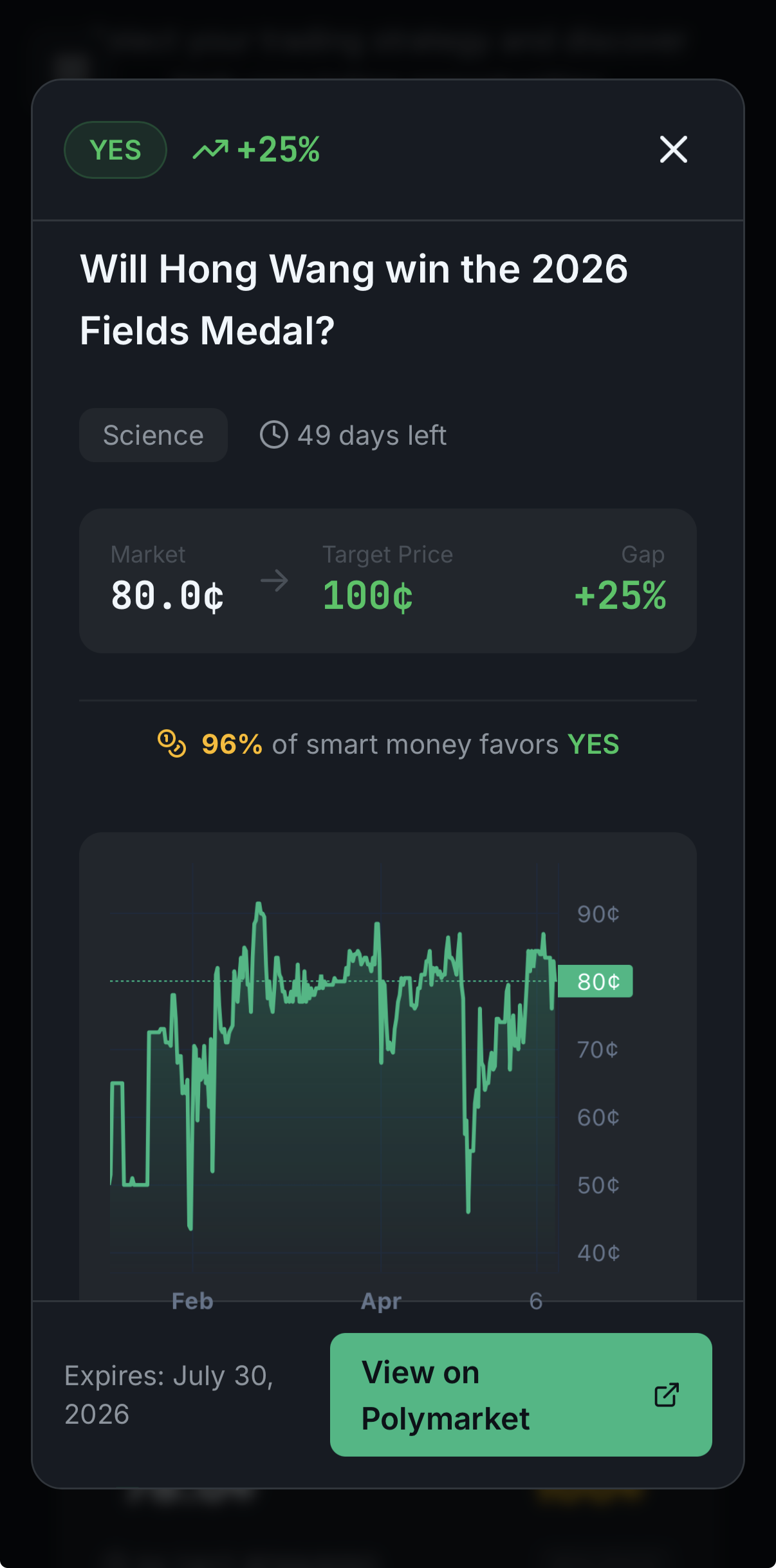
Once holders are scored, a market can be summarized as a split: what share of the informed money sits on YES versus NO. A market where smart money is 55 to 45 is close to a coin flip. A market where 90 percent or more of the informed money sits on one side is a much stronger statement.
The most actionable version is when a lopsided smart money split lines up with a price that has not moved to match. That is the crowd pricing one thing while the proven wallets quietly position for another.
How to actually use it
Two practical ways smart money fits into a process:
- As confirmation. Pair the split with your fair-value read. When a mispricing and the informed money agree on the same side, you have double confirmation. See the mispriced markets guide for the full two-step check.
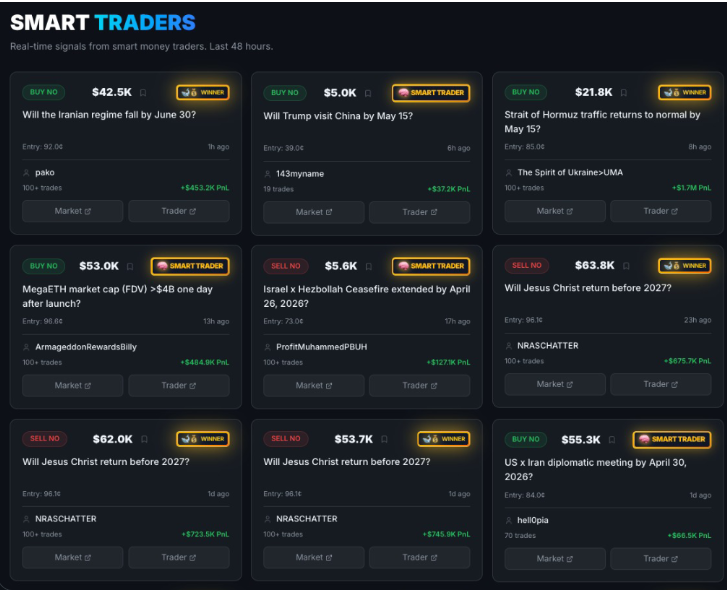
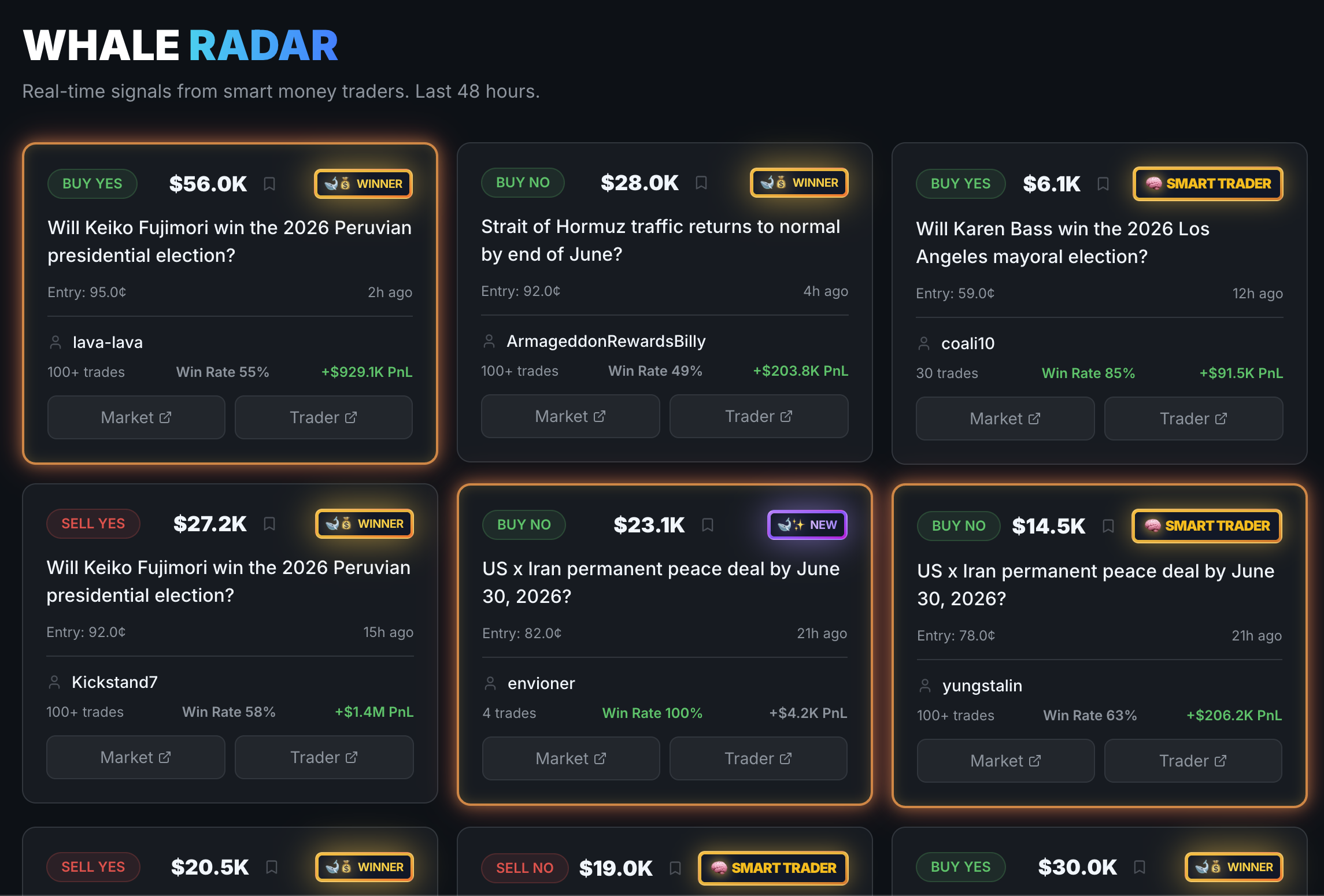
- As a live radar. Watching large trades from proven wallets in real time surfaces where informed money is moving right now, often before the price fully adjusts.
Want to go a step further and follow specific traders? The guide to copy trading on Polymarket compares every copy trading bot and tool available, and covers how to pick who is worth following.
Whale tracking vs smart money: not the same thing
The two get used interchangeably and they should not be. A whale is defined by size. Smart money is defined by record. Plenty of whales are just wealthy people who are wrong loudly, and plenty of the most consistently profitable Polymarket wallets never take a position big enough to trip a whale alert.
Both are useful, for different things. Whale tracking answers “what just moved this market?” because a large enough position shifts price on impact regardless of whether the trader is any good. Smart money answers “who is right more often, and where are they positioned?”
The strongest read is when they agree: a large position, from a wallet that clears the shark thresholds, in a market whose price has not caught up yet. Size tells you it will move the market. Record tells you it deserves to.
Where the smart money read breaks down
Being honest about the failure modes is what keeps this useful rather than superstitious:
- Past profit is not a promise. The thresholds select for wallets that have already had a good run. Some fraction of that is skill and some is variance, and you cannot cleanly separate them from the outside.
- Positions can be hedges. A wallet may be positioned on Polymarket to offset an exposure somewhere else entirely. Their trade is rational for them and meaningless for you.
- Thin markets distort the split. In a market with very few holders, one mid-sized shark position can push the split to 90-plus without saying much.
- It lags fast news. The split reflects positions already taken. In a market repricing on breaking information, it describes the recent past.
- One entity can hold several wallets. What looks like agreement between three sharks can be one trader splitting a position.
Frequently asked questions
What is smart money on Polymarket?
Smart money refers to wallets with a track record of profitable resolved positions over a meaningful number of trades, as opposed to wallets that happen to be holding a large position right now. Size alone does not make a wallet smart. A consistent record across a real sample does.
How do you track profitable wallets on Polymarket?
Every Polymarket position settles on a public blockchain, so you can read any wallet’s holdings, entries, exits and realized profit. Pull the holders of a market, look up each wallet’s all-time profit and lifetime trade count, then judge them on both together rather than on the size of a single position.
What counts as a shark wallet?
In the TrueOdds model a shark is a wallet with more than $10,000 in all-time profit and more than 50 lifetime trades. A professional clears $2,000 profit and 20 trades. Everything else is treated as a gambler. The two conditions matter together: high profit on very few trades is variance, not skill.
Is the smart money indicator a buy signal?
No. A heavy smart money concentration on one side tells you that informed traders disagree with the current price, which is a reason to investigate rather than a reason to enter. Form your own fair value view first and use the split as a second opinion on it.
Can smart money be wrong on Polymarket?
Routinely. Profitable wallets lose individual trades all the time, they can be positioned for reasons that do not apply to you such as hedging an off-platform exposure, and a crowded smart money side can still be the wrong side. It shifts the odds, it does not settle them.
Related guides
Educational content only. Nothing in this guide is financial, investment, or legal advice. TrueOdds is a research and analytics tool. Prediction markets carry risk of loss. Past performance does not predict future results.