Copy trading
How to Copy Trade on Polymarket: Tools, Bots and Risks
9 min readBy TrueOddsUpdated
What you will learn
- Whether Polymarket has built-in copy trading (and what exists instead)
- Every copy trading bot and tool compared, with the risk of each
- The metrics that separate a real track record from a lucky streak
- Why blindly copying entries fails (and what to copy instead)
- How to get notified the moment a trader you follow makes a move
Does Polymarket have copy trading?
No. Polymarket has no built-in copy trading button, and no native setting that automatically mirrors another wallet into your account. If you are looking for a toggle inside the Polymarket interface that copies a trader for you, it does not exist.
What does exist is a growing set of third-party tools built on top of Polymarket, plus the manual approach that most consistently profitable followers actually use. Both are possible for the same reason: Polymarket settles on a public blockchain, so every wallet position, entry and exit is visible to anyone who looks. That transparency is what makes following other traders possible at all.
This guide covers what the tools are, what each one costs you in risk, and how to follow winning traders without inheriting their mistakes.
Polymarket copy trading tools and bots compared
The options fall into three groups: hosted copy trading services, open-source bots you run yourself, and alert-based tools that surface the trade and leave the decision to you. They differ most in one dimension that matters more than features: how much access they need to your money.
| Tool | What it does | Automation | Main risk |
|---|---|---|---|
| Copycat (Stand.Trade) | Hosted service that tracks Polymarket wallets and mirrors selected strategies. The most official-adjacent option, built in collaboration with people close to Polymarket. | Automatic | You inherit the copied wallet's drawdowns in full, at whatever price the fill lands. |
| Poly Syncer | Ranks public wallets by realized profit, win rate and drawdown, then replicates the trades of the ones you pick. | Automatic | Ranking by past profit selects for wallets that have already had their good run. |
| Polycule | Copy trading interface layered over Polymarket wallets. | Automatic | Third-party custody and execution assumptions. |
| Open-source bots (GitHub) | Self-hosted scripts you configure with target wallets and run yourself. Free. | Automatic | Highest. Usually unaudited, and most require your private key to place orders. |
| Screener plus alerts | Rank traders, follow the ones that fit your style, get notified the moment they trade. You place the order. | Manual | You have to be available to act, and you can talk yourself out of good trades. |
There is a real trade-off here rather than a single best answer. Full automation removes the timing problem and removes your judgment at the same time. Alert-based following keeps your judgment in the loop at the cost of needing you to show up.
Is a Polymarket copy trading bot safe?
Safety here is mostly about one question: what does the tool need from you in order to trade? Sort any bot you are considering by that before you look at anything else.
- Private key handover is the red line. A tool that asks you to paste a private key or seed phrase can move every asset in that wallet, not just place the trades you intended. If you use one anyway, use a fresh wallet funded with only what you are willing to lose entirely.
- Unaudited open-source is not automatically safe. Public code means youcould read it. Almost nobody does. A repo with a polished README and no audit is an unknown, not a guarantee.
- Slippage is a silent cost. Prediction market books can be thin. A bot that mirrors a large position into a shallow market moves the price against itself, and you pay that difference on every copied trade.
- Exit handling is where most bots are weakest. Copying entries is easy. Reliably copying the exit, at speed, is not. Check what happens when the trader you copy closes out.
- Custody. Hosted services that hold funds concentrate risk in the operator. Non-custodial tools that trade from your own wallet are structurally safer, though still only as safe as their permissions.
What copy trading realistically returns
Copy trading is usually sold as a shortcut past the hard part. It is worth setting expectations against the actual distribution of outcomes on the platform.
Widely cited analyses of Polymarket put the share of users who are profitable at roughly 12.7%. Read that number carefully, because it reframes the whole exercise: the large majority of wallets you could copy are losing money. Copy trading does not improve your odds by default. It transfers your problem from “pick the right market” to “pick the right trader,” and the second problem is not obviously easier than the first.
It also means the leaderboard is the worst possible shortlist. Ranking wallets by headline profit surfaces whoever has most recently had an outsized run, which is exactly the population most likely to mean-revert. The wallets worth following tend to look boring: moderate returns, high trade counts, small drawdowns, one or two categories.
What copy trading on Polymarket really means
Copy trading is following the moves of traders with a proven track record instead of sourcing every idea yourself. Because Polymarket positions live on the public blockchain, you can see exactly what any wallet holds and when it enters or exits.
Done well it is a discovery engine: a way to surface ideas you would never have found, from people who spend more time on a category than you do. Done blindly it is a fast way to inherit someone else's mistakes at a worse price than they got.
How to find traders worth following
A big number next to a wallet is not enough. Separate a real track record from a lucky streak by looking at several metrics together:
| Metric | Why it matters |
|---|---|
| Win rate | How often their resolved positions came in. Context, not the whole story. |
| Profit and loss | The cumulative result across all their trades over time. |
| Trade count | The sample size. A record over hundreds of trades is far more reliable than a handful. |
| Streak | Recent consistency, useful for spotting who is in form now. |
| Style and category | A politics specialist and a sports specialist are not interchangeable. Match the trader to the markets. |
The goal is a short list of traders whose history is deep, consistent, and focused on markets you understand, rather than the single wallet with the flashiest headline number.
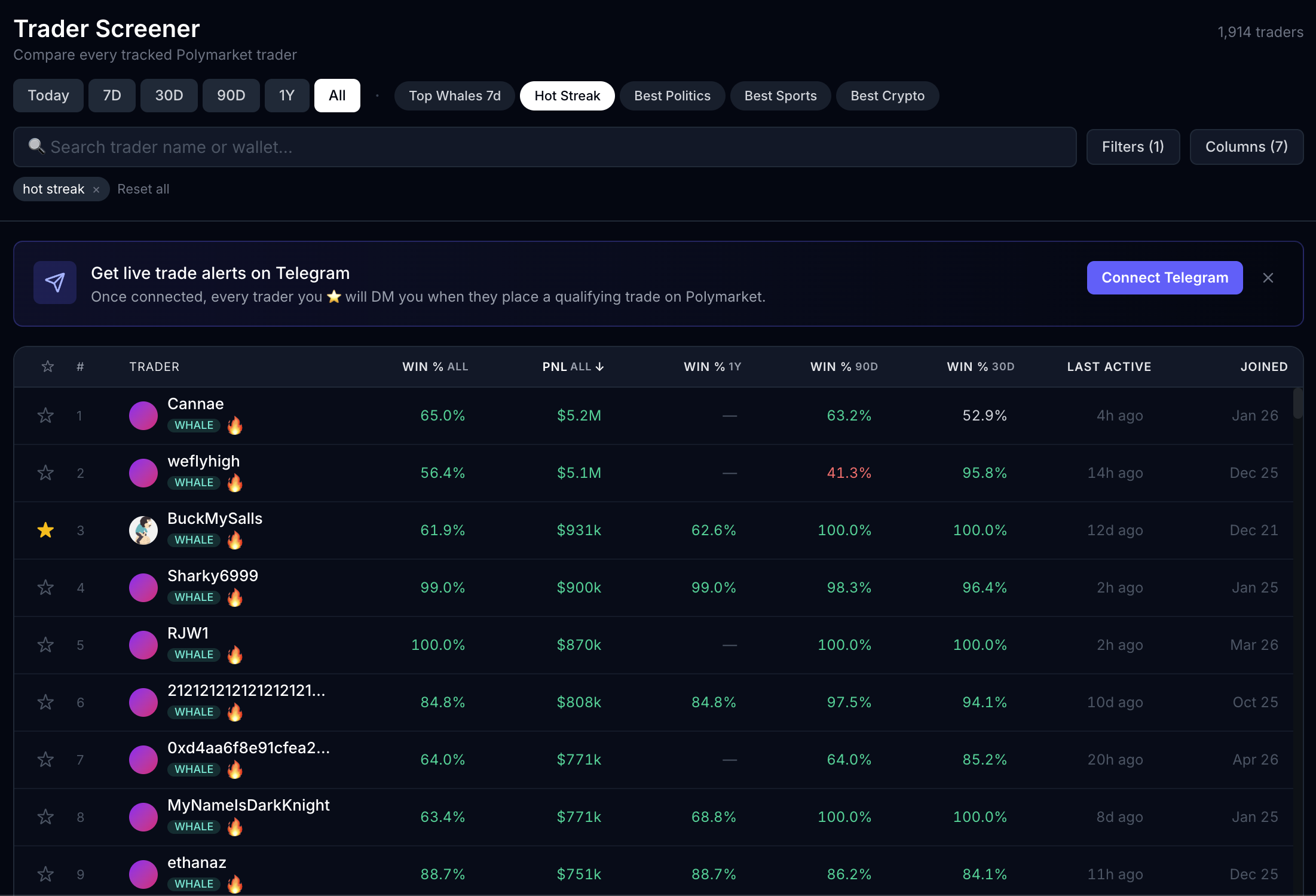
How to copy trade on Polymarket, step by step
This is the alert-based approach, which keeps your judgment in the loop. It takes about twenty minutes to set up.
- 1. Build a shortlist, not a leaderboard. Filter for wallets with a high trade count and a consistent record in one or two categories you can judge yourself. Reject anyone whose profit comes from a handful of enormous positions.
- 2. Check the category overlap. If you cannot form your own opinion on the markets a trader specializes in, you cannot evaluate their moves. You will end up mirroring blindly, which is the failure mode this whole approach exists to avoid.
- 3. Set up alerts. Entry price drift is the single biggest cost in copy trading, and it is worst when you find out late. A notification the moment a followed trader places a trade is what makes the difference between entering near their price and entering after the move.
- 4. Run every alert through your own check. Read the resolution rules. Form a view on fair value. Ask why the price is where it is. If you cannot articulate why the trade is good, skip it, no matter who took it.
- 5. Size against your own bankroll. A position that is 2% of their capital might be 40% of yours. Copy the idea, size it to your rules.
- 6. Track the exit. Decide in advance what you do if the trader closes out, and what you do if they do not. Being left in a position the originator already exited is the most common way followers lose money.
The traps of blind copying
Even a great trader is a bad thing to copy carelessly. Watch for these:
- Entry price drift. By the time you see and mirror a trade, the price has often already moved. You may be entering a worse level than they did, which changes the math entirely.
- Size mismatch. A position that is a small share of their capital might be a huge share of yours. Copy the idea, size it to your own rules.
- Silent exits. If you follow someone in but do not know when they got out, you can be left holding a position they already closed.
- Lucky streaks. A short run of hits is not a track record. Sample size is everything.
- Correlated positions. Copy five traders who all follow the same category and you have one concentrated bet wearing five costumes.
Get notified the moment they move
The practical bottleneck in copy trading is timing. Entry price drift is worst when you find out late, so the traders you follow are only useful if you hear about their moves quickly. That is where alerts change the game: a notification the instant a trader on your list places a trade lets you evaluate it while the price is still close to theirs.
Copy trading works best alongside your own read. Pair it with the smart money guide and the strategy guide to turn followed traders into confirmed setups.
Frequently asked questions
Does Polymarket have copy trading?
Polymarket has no built-in copy trading button. There is no native setting that automatically mirrors another wallet into your account. Copy trading on Polymarket happens through third-party tools, or manually by tracking public wallets and deciding which of their moves to act on yourself.
Is there a Polymarket copy trading bot?
Yes, several third-party bots exist, including hosted services and open-source scripts on GitHub. They vary enormously in how much access they need to your funds, whether the code has been audited, and how they handle slippage. Treat any bot that asks for your private key as high risk.
How do I copy trade on Polymarket?
Identify traders with a deep, consistent record in markets you understand, follow their public wallets, get alerted the moment they trade, then run each move through your own check and size it to your own bankroll rather than mirroring their stake.
Is Polymarket copy trading profitable?
It can be, but it is not automatic. Widely cited analyses put the share of profitable Polymarket users at roughly 12.7%, so most wallets you could copy are losing money. Profitability depends entirely on who you copy, what price you get relative to their entry, and how you size the position.
Can you see other traders positions on Polymarket?
Yes. Polymarket settles on a public blockchain, so every wallet position, entry and exit is visible to anyone. That transparency is what makes following other traders possible in the first place.
Related guides
Educational content only. Nothing in this guide is financial, investment, or legal advice. TrueOdds is a research and analytics tool. Prediction markets carry risk of loss. Past performance does not predict future results.